






go协程切换开销远低于php协程,核心在于go的gmp调度模型采用用户态协作式调度与m:n线程映射,而php-fpm或swoole等环境多依赖操作系统内核线程或模拟协程。go通过`runtime.gosched()`在系统调用或锁竞争时主动让出cpu,配合p(processor)本地运行队列实现无锁高效切换;php若使用传统fpm则是进程级隔离,若用swoole则需手动管理上下文,且受限于zts(线程安全)模型的复杂性。理解这一差异有助于在高并发场景下选择正确的技术栈。

Go的GMP调度模型如何工作
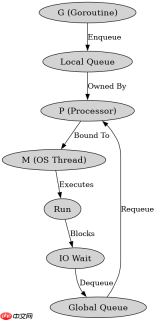
Go的调度器由G(Goroutine)、M(Machine/OS Thread)和P(Processor)组成。G代表协程,M代表操作系统线程,P代表执行上下文。当G需要等待I/O或阻塞时,它会被挂起并放入P的本地队列或全局队列,M则去执行其他G。这种机制避免了频繁的上下文切换开销,因为大部分调度发生在用户态。
package main
import (
    "fmt"
    "runtime"
    "time"
)
func main() {
    // 设置GOMAXPROCS为当前逻辑CPU数量
    runtime.GOMAXPROCS(runtime.NumCPU())

    var wg sync.WaitGroup
    start := time.Now()

    for i := 0; i
<p>上述代码展示了创建10000个Goroutine并行的基本模式。每个Goroutine轻量级,内存占用仅几KB,切换成本极低。运行时会自动将G分配到可用的M上,利用P的本地队列减少锁竞争。</p>
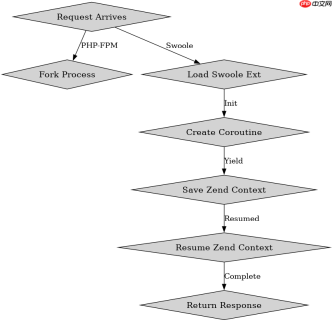
<h2>PHP协程的实现局限在哪里</h2><p>PHP本身是同步阻塞语言,其“协程”通常指Swoole或Amp等框架提供的异步非阻塞能力。Swoole基于C扩展,虽然实现了用户态协程,但其底层仍依赖epoll/kqueue等事件循环,且每次协程切换涉及Zend引擎的上下文保存与恢复,开销远大于Go。此外,PHP-FPM模式下每个请求独立进程,完全不存在协程概念。</p><div class="aritcle_card flexRow artxards">
											<div class="artcardd flexRow">
												<a class="aritcle_card_img" rel="nofollow" href="/xiazai/skill13222" title="Build MCP servers and clients for PHP applications with the official PHP SDK"><img
														src="https://img.php.cn/upload/skill/001/246/273/6adaf20e352aa140.jpg" alt="Build MCP servers and clients for PHP applications with the official PHP SDK" onerror="this.onerror='';this.src='/static/lhimages/moren/morentu.png'" ></a>
												<div class="aritcle_card_info flexColumn">
													<a rel="nofollow" href="/xiazai/skill13222" title="Build MCP servers and clients for PHP applications with the official PHP SDK" class="overflowclass">Build MCP servers and clients for PHP applications with the official PHP SDK</a>
													<p class="overflowclass">使用官方Model Context Protocol PHP SDK将PHP应用程序功能暴露为MCP工具、资源和提示,用于代理工作流。</p>
												</div>
												<a rel="nofollow" href="/xiazai/skill13222" title="Build MCP servers and clients for PHP applications with the official PHP SDK" class="aritcle_card_btn flexRow flexcenter"><b></b><span>下载</span>
												</a>
											</div>
										</div><p>@@##@@</p>
<pre class="brush:php;toolbar:false;">// Swoole示例:简单的HTTP服务器
use Swoole\Http\Server;

$server = new Server("127.0.0.1", 9501);

$server->on("request", function ($request, $response) {
    // 模拟耗时操作
    Co::sleep(1);
    $response->header("Content-Type", "text/html");
    $response->end("Hello from Swoole Coroutine");
});

$server->start();
在Swoole中,`Co::sleep()`会触发协程挂起,但底层仍需经过Swoole的事件循环处理。相比Go原生支持的多核并行和零拷贝网络栈,PHP在处理高并发连接时更容易遇到瓶颈,尤其是在ZTS开启后,线程安全带来的额外开销更为显著。
为什么Go的goroutine比PHP的swoole coroutine更轻
Go的Goroutine是语言级别的原生特性,调度器直接管理其生命周期,无需额外的扩展层。而Swoole作为PHP扩展,需要在Zend VM之上构建抽象层,导致每次切换都涉及解释器状态的保存与恢复。此外,Go的垃圾回收器和内存分配器针对高并发进行了优化,进一步降低了运行时开销。
php免费学习视频:立即使用
踏上前端学习之旅,开启通往精通之路!从前端基础到项目实战,循序渐进,一步一个脚印,迈向巅峰!