






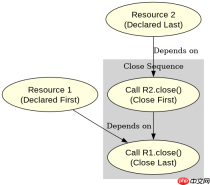
java 7 引入的 try-with-resources 机制通过自动调用资源的 close() 方法,利用资源声明的顺序从后往前(逆序)执行关闭操作。这意味着最后声明的资源会最先被关闭,而最先声明的资源会最后被关闭。这种设计确保了依赖关系明确的资源能够按照正确的顺序释放,例如先关闭数据库结果集,再关闭数据库连接。

try-with-resources 中资源声明顺序与关闭顺序的关系是什么
在 try-with-resources 语句中,多个资源可以在括号内用分号分隔进行声明。JVM 会在退出 try 块时,严格按照这些资源声明的逆序来调用它们的 close() 方法。如果资源 A 依赖于资源 B,那么资源 A 应该写在资源 B 之前,这样 A 就会在 B 之后被关闭,从而保证依赖关系的正确性。
import java.io.*;

public class ResourceOrderDemo {
    public static void main(String[] args) {
        // 模拟两个资源
        Resource r1 = new Resource("Resource-1");
        Resource r2 = new Resource("Resource-2");

        // r1 先声明,r2 后声明
        // 关闭顺序将是:r2.close() -> r1.close()
        try (Resource r1 = r1; Resource r2 = r2) {
            System.out.println("Inside try block");
        } catch (Exception e) {
            e.printStackTrace();
        }
    }
}

class Resource implements AutoCloseable {
    private String name;

    public Resource(String name) {
        this.name = name;
    }

    @Override
    public void close() throws Exception {
        System.out.println("Closing: " + name);
    }
}
运行上述代码将输出:
Inside try block
Closing: Resource-2
Closing: Resource-1
这证实了后声明的 Resource-2 先被关闭,先声明的 Resource-1 后被关闭。
当资源关闭过程中抛出异常时,try-with-resources 如何处理
如果在关闭资源的过程中发生异常,try-with-resources 会将该异常作为“抑制异常”附加到主 try 块中抛出的任何异常上。如果主 try 块没有抛出异常,但关闭资源时抛出了异常,则该异常会被直接抛出。开发者可以通过 getSuppressed() 方法获取所有被抑制的异常列表,以便进行完整的错误分析。

一个基于源码的 OpenAI Agents SDK JavaScript 和 TypeScript 技术文档。涵盖了代理编排、工具、转接、追踪以及实际安装路径。

import java.io.*;

public class SuppressedExceptionDemo {
    public static void main(String[] args) {
        ResourceWithException r1 = new ResourceWithException("R1");
        ResourceWithException r2 = new ResourceWithException("R2");

        try (ResourceWithException r1 = r1; ResourceWithException r2 = r2) {
            throw new RuntimeException("Main Error");
        } catch (Exception e) {
            System.out.println("Caught: " + e.getMessage());
            for (Throwable t : e.getSuppressed()) {
                System.out.println("Suppressed: " + t.getMessage());
            }
        }
    }
}

class ResourceWithException implements AutoCloseable {
    private String name;

    public ResourceWithException(String name) {
        this.name = name;
    }

    @Override
    public void close() throws Exception {
        System.out.println("Closing: " + name);
        if (name.equals("R2")) {
            throw new IOException("Error closing R2");
        }
    }
}
运行结果:
Inside try block
Closing: R2
Closing: R1
Caught: Main Error
Suppressed: Error closing R2
这里 R2 先关闭并抛出异常,该异常被抑制并附加到主异常 Main Error 上。
基于程序中某个输入、条件或结果的具体问题
在上述示例中,当 R2 关闭时抛出异常,而主 try 块也抛出异常时,最终捕获到的异常是主异常,而 R2 的关闭异常作为抑制异常存在。这是 Java 7+ 的标准行为,旨在保留原始错误上下文的同时不丢失资源清理阶段的错误信息。
Java免费学习笔记:立即使用
解锁 Java 大师之旅:从入门到精通的终极指南


