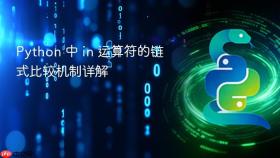
Python 的 in 是可链式使用的比较运算符,其行为遵循“隐式逻辑与”规则:a in b in c 等价于 a in b and b in c,且中间表达式仅计算一次,兼具简洁性与安全性。
python 的 `in` 是可链式使用的比较运算符,其行为遵循“隐式逻辑与”规则:`a in b in c` 等价于 `a in b and b in c`,且中间表达式仅计算一次,兼具简洁性与安全性。
你可能在调试时偶然写出类似 "test" in "testing" in "testing" in "testing" 的表达式,并惊讶于它竟能合法运行且返回 True——这并非语法糖或特例,而是 Python 比较运算符(comparison operators)统一设计原则的自然体现。
✅ 链式 in 的本质:隐式 and 连接
根据 Python 官方文档「Comparisons」章节,所有比较运算符(包括 ==, !=, , <code>, <code>in, is, not in, is not 等)均支持链式写法,其语义被明确定义为:
a op1 b op2 c ... y opN z
等价于a op1 b and b op2 c and ... and y opN z,
但每个操作数(如b,c)仅被求值一次。
因此,你的例子:
"test" in "testing" in "testing" in "testing"
实际等价于:
("test" in "testing") and ("testing" in "testing") and ("testing" in "testing")
# → True and True and True → True
⚠️ 注意:这不是从左到右逐步嵌套(如 "test" in ("testing" in "testing")),后者会报错(因为 "testing" in "testing" 返回 True,而 True in "testing" 无意义)。链式比较是横向展开,而非纵向嵌套。

? 实用示例与常见陷阱
✅ 合理链式场景(语义清晰、提升可读性)
# 检查数值是否落在区间内(比写两个 and 更简洁)
if 0 <h4>⚠️ 易误解的“伪链式”(看似链式,实则逻辑错误)</h4><pre class="brush:php;toolbar:false;"># ❌ 错误理解:以为是 "test" in ("testing" in "testing")
# 实际上:("test" in "testing") and ("testing" in "testing") → True and True
print("test" in "testing" in "testing")  # True

# ❌ 更迷惑的例子(源自提问):
print(True in [True] in [True])  # False!为什么?
# 展开为:(True in [True]) and ([True] in [True])
# → True and False → False(因为 [True] 不在 [True] 中,列表不等于自身引用)
这个经典陷阱揭示了链式 in 的关键约束:中间操作数必须同时满足左侧的“成员资格”和右侧的“被包含对象”双重角色。[True] in [True] 为 False,因为列表对象不包含自身(除非显式构造循环引用)。
? 为什么允许链式?设计哲学与优势
- 一致性:统一处理所有比较运算符,降低学习成本;
-
安全性:避免重复求值副作用(如
func() in lst in func()中func()只执行一次); -
表达力:自然描述数学/逻辑中的区间、序列包含关系(如
a 或 <code>x in container in larger_container)。
? 小知识:
not in也参与链式,但需注意优先级。例如:x not in a in b等价于(x not in a) and (a in b),而非x not in (a in b)。
✅ 最佳实践建议
- ✅ 推荐使用:链式比较用于语义连贯、中间值稳定的场景,如范围检查(
low )、多重成员判断(当容器本身是明确可包含对象时); - ⚠️ 谨慎使用:避免在链式中混用不同语义的容器(如
str in list in dict),易引发逻辑混淆; - ❌ 避免滥用:
"a" in s in s in s类写法虽合法,但无实际价值,损害可读性;应优先选择清晰、意图明确的代码。
总之,in 的链式能力不是“隐藏彩蛋”,而是 Python 比较运算符体系严谨设计的体现。理解其底层展开规则(隐式 and + 单次求值),就能安全、精准地驾驭这一特性,写出既 Pythonic 又健壮的代码。
Python免费学习笔记(深入):立即使用
在学习笔记中,你将探索 Python 的核心概念和高级技巧!