





命令简介:
该命令用来重启Linux系统。相当于Windows系统中的restart命令。
命令语法:
/sbin/reboot [-n] [-w] [-d] [-f] [-i]
或
reboot [-n] [-w] [-d] [-f] [-i]
命令参数:
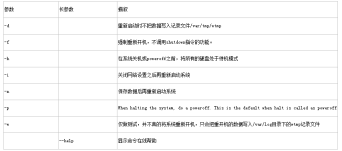

使用示例:
1: 查看reboot命令的帮助信息
[root@DB-Server ~]# reboot --help
usage: reboot [-n] [-w] [-d] [-f] [-h] [-i]
        -n: don't sync before halting the system
        -w: only write a wtmp reboot record and exit.
        -d: don't write a wtmp record.
        -f: force halt/reboot, don't call shutdown.
        -h: put harddisks in standby mode.
        -i: shut down all network interfaces.
[root@DB-Server ~]# man reboot
[root@DB-Server ~]# man reboot
HALT(8)               Linux System Administrator鈥檚 Manual              HALT(8)

NAME
       halt, reboot, poweroff - stop the system.

SYNOPSIS
       /sbin/halt [-n] [-w] [-d] [-f] [-i] [-p] [-h]
       /sbin/reboot [-n] [-w] [-d] [-f] [-i]
       /sbin/poweroff [-n] [-w] [-d] [-f] [-i] [-h]

DESCRIPTION
       Halt notes that the system is being brought down in the file /var/log/wtmp, and then either tells the kernel to halt, reboot or poweroff the system.

       If  halt  or reboot is called when the system is not in runlevel 0 or 6, in other words when it鈥檚 running normally, shutdown will be invoked instead (with
       the -h or -r flag). For more info see the shutdown(8) manpage.

       The rest of this manpage describes the behaviour in runlevels 0 and 6, that is when the systems shutdown scripts are being run.

OPTIONS
       -n     Don鈥檛 sync before reboot or halt. Note that the kernel and storage drivers may still sync.

       -w     Don鈥檛 actually reboot or halt but only write the wtmp record (in the /var/log/wtmp file).

       -d     Don鈥檛 write the wtmp record. The -n flag implies -d.

       -f     Force halt or reboot, don鈥檛 call shutdown(8).

       -i     Shut down all network interfaces just before halt or reboot.

       -h     Put all harddrives on the system in standby mode just before halt or poweroff.

       -p     When halting the system, do a poweroff. This is the default when halt is called as poweroff.

DIAGNOSTICS
       If you鈥檙e not the superuser, you will get the message 鈥榤ust be superuser鈥?  Users logged in locally on the console can call  halt,  reboot,  and  poweroff
       without supplying the root password, due to pam_console (8).

NOTES
       Under  older sysvinit releases , reboot and halt should never be called directly. From release 2.74 on halt and reboot invoke shutdown(8) if the system is
       not in runlevel 0 or 6. This means that if halt or reboot cannot find out the current runlevel (for example, when /var/run/utmp  hasn鈥檛  been  initialized
       correctly) shutdown will be called, which might not be what you want.  Use the -f flag if you want to do a hard halt or reboot.

       The  -h  flag puts all harddisks in standby mode just before halt or poweroff. Right now this is only implemented for IDE drives. A side effect of putting
       the drive in standby mode is that the write cache on the disk is flushed. This is important for IDE drives, since the kernel doesn鈥檛 flush the write-cache
       itself before poweroff.

       The  halt  program  uses  /proc/ide/hd* to find all IDE disk devices, which means that /proc needs to be mounted when halt or poweroff is called or the -h
       switch will do nothing.

AUTHOR
       Miquel van Smoorenburg, miquels@cistron.nl

SEE ALSO
       shutdown(8), init(8), pam_console(8)

                                  Nov 6, 2001                          HALT(8)
(END)
2:强制重新开机,不调用shutdown指令的功能
[root@DB-Server ~]# reboot -f
3:关闭网络设置之后再重新启动系统
[root@DB-Server ~]# reboot -i

Broadcast message from root (pts/1) (Mon Jul 28 11:31:28 2014):

The system is going down for reboot NOW!
4:保存数据后再重新启动系统
[root@DB-Server ~]# reboot -n

Broadcast message from root (pts/1) (Mon Jul 28 11:33:57 2014):

The system is going down for reboot NOW!
5:重新启动时不把数据写入记录文件/var/tmp/wtmp
[root@DB-Server ~]# reboot -d

Broadcast message from root (pts/2) (Mon Jul 28 11:23:26 2014):

The system is going down for reboot NOW!


