






使用 promise.all() 结合数组的 filter() 方法可以实现异步操作的并行过滤。具体做法是先用 map 将原始数据映射为包含判断逻辑的 promise 数组,然后调用 promise.all() 等待所有异步检查完成,最后根据返回结果筛选出符合条件的元素。

Promise.all() 如何并行执行多个异步条件检查
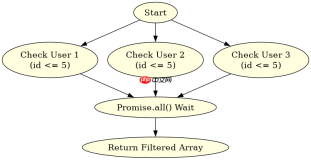
Promise.all() 接收一个 Promise 数组作为参数,它会并行启动所有任务,并在所有任务都 resolve 后返回一个包含所有结果的数组。在并行过滤场景中,这意味着所有的异步验证(如网络请求、数据库查询)会同时开始,而不是串行等待,从而显著减少总耗时。
async function filterAsync(arr, asyncPredicate) {
  const results = await Promise.all(
    arr.map(item => asyncPredicate(item))
  );
  return arr.filter((_, index) => results[index]);
}

// 示例:过滤掉 ID 大于 5 的用户
const users = [
  { id: 1, name: 'Alice' },
  { id: 6, name: 'Bob' },
  { id: 3, name: 'Charlie' }
];

const validUsers = await filterAsync(users, async (user) => {
  // 模拟异步检查
  return user.id <p>运行上述代码,预期输出为包含 Alice 和 Charlie 的对象数组。因为 Bob 的 ID 为 6,不满足小于等于 5 的条件,被过滤掉。整个过程三个用户的检查是并行执行的。</p><h2>如何处理异步过滤中的错误与异常</h2><p>当异步谓词函数中发生错误时,<code>Promise.all()</code> 会立即 reject,导致整个过滤操作失败。为了健壮地处理这种情况,通常结合 <code>Promise.allSettled()</code> 或捕获单个 Promise 的错误来实现容错过滤。</p><div class="aritcle_card flexRow artxards">
											<div class="artcardd flexRow">
												<a class="aritcle_card_img" rel="nofollow" href="/xiazai/skill13095" title="Build Java agent transport gateways with Atmosphere"><img
														src="https://img.php.cn/upload/skill/001/246/273/6adaf20e352aa140.jpg" alt="Build Java agent transport gateways with Atmosphere" onerror="this.onerror='';this.src='/static/lhimages/moren/morentu.png'" ></a>
												<div class="aritcle_card_info flexColumn">
													<a rel="nofollow" href="/xiazai/skill13095" title="Build Java agent transport gateways with Atmosphere" class="overflowclass">Build Java agent transport gateways with Atmosphere</a>
													<p class="overflowclass">使用Atmosphere构建通过WebSocket、SSE、gRPC、WebTransport、MCP、A2A和AG-UI流传输的JVM代理网关,并带有治理钩子。</p>
												</div>
												<a rel="nofollow" href="/xiazai/skill13095" title="Build Java agent transport gateways with Atmosphere" class="aritcle_card_btn flexRow flexcenter"><b></b><span>下载</span>
												</a>
											</div>
										</div><p><img src="https://img.php.cn/upload/article/001/242/473/179480392174213.png?x-oss-process=image/resize,p_40" alt="JavaScript Promise 怎么实现异步操作的并行过滤"></p><pre class="brush:php;toolbar:false;">async function filterAsyncSafe(arr, asyncPredicate) {
  const results = await Promise.allSettled(
    arr.map(item => asyncPredicate(item).catch(() => false))
  );
  return arr.filter((_, index) => results[index].status === 'fulfilled' && results[index].value);
}

// 示例:处理可能抛出异常的异步检查
const items = [1, 2, 3];
const filteredItems = await filterAsyncSafe(items, async (item) => {
  if (item === 2) throw new Error('Invalid item');
  return true;
});

console.log(filteredItems); // [1, 3]
运行上述代码,预期输出为 [1, 3]。当处理 item 2 时,异步谓词抛出异常,.catch(() => false) 将其转换为 false,使得该元素在最终过滤中被排除,而不会中断整个流程。
基于输入数组长度对并行过滤性能的影响
并行过滤的性能主要受限于并发数量和网络/IO延迟。当输入数组很大时,同时发起大量异步请求可能导致资源耗尽或触发服务器的速率限制。此时需要考虑分批处理或使用并发控制库。
在实际应用中,如果输入数组包含 1000 个元素,且每个元素都需要进行网络请求,直接并行可能会造成压力。可以通过限制并发数来优化,例如每次只处理 10 个元素,但这会牺牲部分并行优势。对于大多数中等规模的数据集,直接使用 Promise.all() 是最简洁高效的方案。
Java免费学习笔记:立即使用
解锁 Java 大师之旅:从入门到精通的终极指南





